
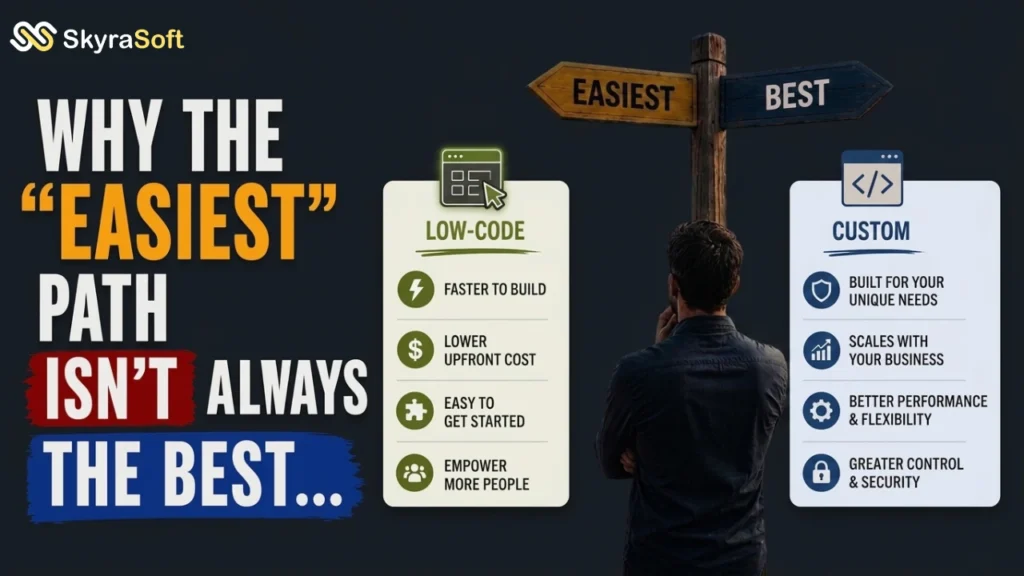
The Low-Code Explosion – Promise and Peril
Low-code and no-code platforms have exploded in popularity, and for good reason. They allow non-technical teams to build functional applications quickly – sometimes in days or weeks rather than months. Marketing teams build landing pages with integrated forms. Operations teams automate approval workflows. Sales teams create custom dashboards. The democratization of software creation is real and valuable.
But “quick” and “right for your business” are not the same thing. Low-code platforms now power 75% of new applications, but they come with significant trade-offs: limited customization, vendor lock-in, scalability constraints, and security concerns. The very features that make low-code fast – pre-built components, simplified logic, abstracted infrastructure – become limitations when your requirements grow beyond what the platform anticipated.
The peril of low-code is not that it never works. It is that it works well enough initially, then fails when you need it most. A prototype built in a week becomes a production system running critical operations. The business becomes dependent on workflows that cannot be migrated easily. When the platform changes its pricing, deprecates a feature, or goes out of business, the business faces a crisis. The “easy” path becomes the expensive path.
This article does not argue against low-code. It argues for intentionality – choosing the right tool for the right job, with full awareness of the trade-offs. For many business needs, low-code is perfect. For others, custom development is not just better – it is necessary.
The Hidden Costs of Low-Code Platforms
The price tag of a low-code platform – often $20-100 per user per month – is not the total cost. The hidden costs emerge over time and often exceed the initial savings.
Vendor lock-in is the most significant hidden cost. Your application logic, data models, and user interfaces are built on proprietary constructs that do not export to other platforms. Migrating off a low-code platform typically requires a complete rebuild. The longer you use the platform, the more expensive migration becomes. Vendors know this, which is why they can raise prices with relative impunity.
Scalability constraints are another hidden cost. Low-code platforms abstract infrastructure, which is convenient until you need to scale. When your application grows beyond the platform’s designed capacity, you cannot simply upgrade servers or optimize queries – you are limited by the platform’s architecture. Businesses that experience rapid growth often find their low-code applications becoming performance bottlenecks.
Security and compliance present additional challenges. Low-code platforms store your data on their infrastructure, subject to their security policies. For businesses handling sensitive customer data, protected health information, or financial records, this may violate compliance requirements. Even when compliance is technically possible, proving it to auditors becomes more difficult when you don’t control the underlying infrastructure.
Integration limitations accumulate over time. Low-code platforms offer pre-built connectors to popular services, but they rarely support the specific, legacy, or niche systems that matter to your business. Custom integrations require workarounds that add complexity and fragility. What started as a simple application becomes a tangled web of middleware, scheduled tasks, and error-prone data synchronization.
When Low-Code Makes Sense
Despite these trade-offs, low-code platforms are the right choice for many business needs. The key is recognizing which needs fit the low-code model.
Internal tools with limited users and low stakes are ideal for low-code. A team task tracker, a content approval system, an event registration form – these applications have modest requirements and can be rebuilt if necessary. The speed of low-code development far outweighs the risks of vendor lock-in or scalability constraints.
Prototypes and proofs of concept benefit enormously from low-code. Testing an idea with real users before committing to custom development saves time and money. If the prototype succeeds, you can rebuild it properly. If it fails, you have lost only the low-code effort. This build-test-rebuild cycle is far more efficient than starting with custom development.
Workflow automation that connects existing SaaS tools is a sweet spot for low-code. Platforms like Zapier, Make, and Power Automate excel at moving data between applications, triggering actions based on events, and orchestrating multi-step processes. These automations are typically small in scope and easy to replace if needed.
Non-critical customer-facing applications can work on low-code when requirements are standard. A basic e-commerce store, a simple membership site, or a portfolio showcase can be built on low-code platforms like Webflow, Bubble, or Squarespace. When your needs exceed these platforms’ capabilities – custom checkout, complex pricing, personalized content – that is the signal to move to custom development.
The Custom Development Advantage for Core Systems
For applications that are strategic, complex, or customer-facing, custom development provides advantages that low-code cannot match.
Tailored workflows are the most obvious advantage. Custom applications implement exactly your processes, not a generic approximation. Every field, every validation rule, every automation reflects how your business actually works. This precision reduces errors, speeds up work, and eliminates the “workarounds for the workaround” that plague low-code implementations.
Unified data is a less obvious but equally important advantage. Off-the-shelf and low-code applications each maintain their own databases, creating data silos. Custom applications can share a single database, ensuring that customer information, order history, inventory levels, and other critical data are consistent across all systems. This unification enables reporting and analytics that are impossible when data is fragmented.
Freedom from platform dependency protects your business from vendor risk. When you own the code, you control the roadmap. You can switch hosting providers, bring development in-house, or change agencies without rebuilding from scratch. This optionality has real economic value, even if it never needs to be exercised.
Performance optimization is another custom advantage. Low-code platforms apply one-size-fits-all performance settings. Custom applications can be optimized specifically for your data volumes, traffic patterns, and user behaviors. Caching strategies, database indexing, and frontend delivery can all be tuned to your exact requirements, delivering speed that low-code cannot match.
A Hybrid Approach – Getting the Best of Both Worlds
The choice between low-code and custom is not binary. Many successful businesses use both, matching the tool to the need.
Low-code for exploration, custom for production. Build prototypes and internal tools on low-code. When an application proves valuable and becomes critical, rebuild it on custom infrastructure. This approach captures the speed of low-code for experimentation while ensuring that production systems have the reliability, scalability, and ownership of custom development.
Low-code for integration, custom for core logic. Use low-code platforms to connect custom applications to external services. A custom CRM might use Zapier to sync with a marketing email platform. A custom inventory system might use Make to send purchase orders to suppliers. The custom application handles the complex core logic; low-code handles the standard integrations.
Low-code for frontend, custom for backend. Some organizations build custom APIs and databases, then use low-code frontend tools to create user interfaces. This hybrid preserves control over data and business logic while accelerating UI development. When the low-code frontend becomes limiting, it can be replaced without disrupting the backend.
The question is not whether to build custom or use low-code. The question is whether you want to own your solution or rent someone else’s. For strategic, differentiating, or customer-facing systems, ownership matters. For internal tools, prototypes, and commodity functions, renting is fine. The smartest businesses know the difference and choose accordingly.