
WooCommerce—The Flexible but Fragmented Alternative
WooCommerce’s strengths are significant and explain its global popularity. As a WordPress plugin, it inherits all the flexibility of the world’s most popular CMS. Store owners can customize virtually anything: product pages, checkout flows, email templates, shipping calculations, and tax rules. The plugin ecosystem provides thousands of extensions for additional functionality. And the core software is free, with costs limited to hosting, premium extensions, and developer time.
However, WooCommerce’s flexibility comes with hidden costs that become apparent as businesses scale. Because WooCommerce is self-hosted, the store owner is responsible for security, performance optimization, backups, and updates. Each of these responsibilities requires technical expertise or paid support. A WooCommerce store with 50 plugins might need hours of monthly maintenance to keep everything updated and compatible. A security vulnerability in any one plugin—or in the WordPress core, or in the hosting environment—can compromise the entire store.
Performance is another challenge. WooCommerce adds significant database queries and PHP execution to every page load. A well-optimized WooCommerce store on quality hosting can perform admirably, but achieving that optimization requires expertise in caching, database indexing, and server configuration. Many store owners never achieve it, resulting in slow load times that kill conversions.
The checkout experience in WooCommerce is particularly problematic. While third-party plugins can improve it, the native WooCommerce checkout is multi-step, requires page reloads, and lacks the polish of Shopify’s embedded checkout. Cart abandonment rates on WooCommerce stores tend to be higher as a result, directly impacting revenue.
For businesses with development resources and specific customization needs, WooCommerce remains an excellent choice. For businesses that want to focus on marketing, products, and customers rather than server maintenance and security patches, Shopify’s managed approach becomes increasingly attractive as order volume grows.
BigCommerce—The Enterprise Challenger
BigCommerce positions itself as Shopify’s primary enterprise competitor, and in some areas, it delivers compelling advantages. Unlike Shopify, BigCommerce does not charge transaction fees on any pricing plan, regardless of payment gateway. For high-volume merchants processing millions in annual revenue, this fee difference can be substantial. BigCommerce also includes more built-in features than Shopify, including advanced product filtering, customer groups, and price lists.
The platform’s native multi-channel selling is particularly strong. BigCommerce integrates directly with Amazon, eBay, Walmart, and Instagram, with inventory synchronization across all channels. For brands selling on multiple marketplaces, this centralization saves significant operational time.
However, BigCommerce’s design flexibility lags behind Shopify. The platform uses a template system that is more restrictive, and customizing beyond template limitations requires significant development work. The checkout process, while improved, remains less customizable than Shopify’s. And the ecosystem of third-party apps, while growing, is much smaller than Shopify’s, meaning store owners have fewer options for extending functionality.
BigCommerce also faces challenges with pricing as businesses scale. While the entry-level plans are competitive, the enterprise plans become expensive quickly. Shopify’s pricing scales more gradually, with the Advanced plan at $399/month before custom enterprise pricing. For most mid-market businesses, Shopify offers better value.
The market’s verdict is visible in adoption numbers. BigCommerce powers approximately 2% of all e-commerce sites, far behind both WooCommerce and Shopify. While it serves some notable enterprise clients, it has not achieved the platform momentum of its larger competitors. For businesses with very high volume and specific multi-channel needs, BigCommerce is worth evaluating; for most others, Shopify offers a better combination of features, ecosystem, and growth path.
Magento/Adobe Commerce—Raw Power at High Cost
Magento, now Adobe Commerce, represents the extreme end of the e-commerce platform spectrum. It is extraordinarily powerful, infinitely customizable, and capable of supporting the most complex e-commerce operations in the world. Major global brands including Coca-Cola, Nike, and Ford use Magento. It can handle millions of products, dozens of store views, complex international tax and shipping rules, and B2B workflows that other platforms cannot accommodate.
However, this power comes at tremendous cost. Magento is self-hosted and requires significant server resources—often multiple dedicated servers or a cloud cluster. Development costs are an order of magnitude higher than Shopify or WooCommerce. A basic Magento store might cost $50,000 to build; a complex one can exceed $500,000. Ongoing maintenance requires specialized developers who command premium rates. Hosting for a production Magento store often exceeds $2,000 per month.
For enterprise businesses with seven-figure monthly revenue and unique requirements that no other platform can meet, these costs are justifiable. For the vast majority of businesses—including most doing millions in annual revenue—Magento is overkill. The complexity slows down development, makes testing and updates difficult, and requires dedicated technical staff.
Shopify Plus, the enterprise tier of Shopify, targets exactly this market segment. It offers many of the same capabilities as Magento—custom checkout, script-based pricing, dedicated infrastructure—but with vastly lower implementation and maintenance costs. The market has responded: Shopify Plus now powers thousands of enterprise brands, including Gymshark, Allbirds, and Heinz. While Magento retains its place at the very high end, Shopify is steadily capturing the mid-enterprise market that previously defaulted to Magento.
Where the Market Is Actually Headed
E-commerce platform selection has historically been dominated by a trade-off: flexibility versus ease of use. Platforms like WooCommerce and Magento offered maximum flexibility but required technical expertise. Platforms like Squarespace and Wix offered ease of use but limited customization. Shopify successfully occupies the middle ground—flexible enough for most businesses, easy enough for non-technical users, and scalable enough for enterprises.
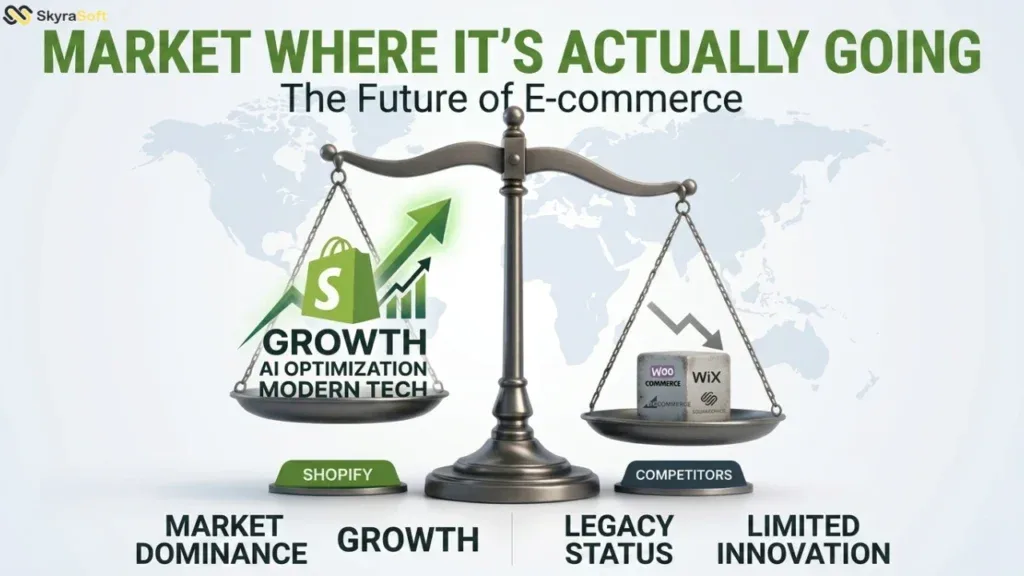
The market is moving decisively toward this middle ground. E-commerce businesses increasingly prefer to invest resources in marketing, product development, and customer acquisition rather than server management, security patches, and plugin compatibility. The SaaS model that Shopify pioneered—pay a monthly fee, receive automatic updates, built-in security, and reliable performance—has become the expectation rather than the exception.
Headless commerce represents the next evolution. Headless architecture separates the frontend presentation layer from the backend commerce engine, allowing each to be optimized independently. Shopify’s Hydrogen framework enables headless development while maintaining Shopify’s cart, checkout, and product management. This approach combines Shopify’s reliable backend with the performance and design flexibility of modern frontend frameworks.
The rise of social commerce and marketplaces further shapes platform selection. Shopify’s integrations with TikTok, Instagram, Facebook, and Pinterest allow merchants to sell directly within social apps. Its partnership with Amazon, while complex, provides another distribution channel. Platforms that cannot offer these integrations will lose merchants who want to meet customers where they already spend time.
Looking ahead, AI-powered personalization, augmented reality product visualization, and voice commerce will become standard expectations rather than differentiators. Shopify’s scale allows it to invest in these capabilities and distribute them to all merchants. Smaller platforms lack this resource advantage. For businesses planning to operate in e-commerce for the next five to ten years, platform momentum matters. Shopify has it. Its competitors, with the exception of the enterprise-focused Adobe Commerce, are losing it.
Making the Right Choice for Your Business
No single platform is best for every business. The right choice depends on technical resources, budget, customization requirements, and growth trajectory. However, a framework for decision-making helps cut through marketing claims and focus on what matters.
For businesses with zero technical resources—no in-house developers, no budget for agencies—SaaS platforms are the only realistic choice. Shopify, BigCommerce, and Squarespace all work. Among these, Shopify offers the best combination of features and ecosystem. The monthly cost is trivial compared to the revenue potential.
For businesses with some technical resources but not dedicated e-commerce developers, Shopify remains the strongest choice. WooCommerce is viable but requires ongoing maintenance that will consume developer time better spent on other priorities. The total cost of ownership for WooCommerce—hosting, security, updates, plugin licenses, developer time—often exceeds Shopify’s subscription fees by a significant margin when fully accounted for.
For businesses with dedicated e-commerce development teams and complex requirements that Shopify cannot meet, WooCommerce or Magento may be appropriate. This category includes businesses with unusual product configurations, legacy system integrations, or regulatory requirements that dictate self-hosting. However, these businesses should regularly reassess whether Shopify’s capabilities have caught up to their needs. The platform evolves rapidly, and what was impossible two years ago may be standard today.
The market trend is unambiguous: managed platforms are gaining share against self-hosted alternatives. Shopify leads this transition. For businesses launching new e-commerce operations or replatforming existing ones, Shopify should be the default option—chosen unless specific requirements justify an alternative. The science of e-commerce conversion increasingly favors platforms that remove friction, automate maintenance, and allow merchants to focus on customers rather than servers.