
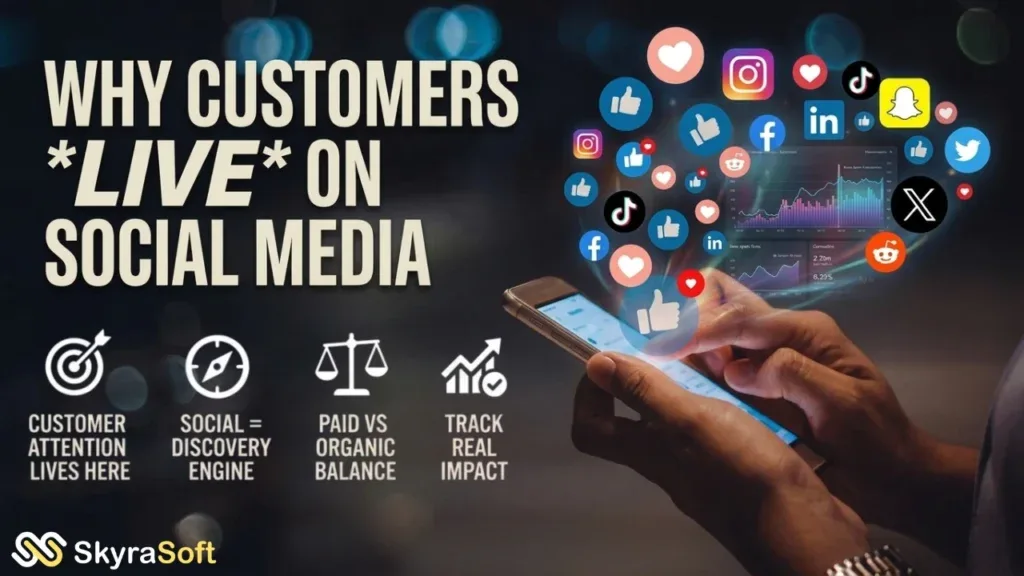
Where Your Customers Actually Spend Their Time
Understanding platform demographics is the first step in multi-channel strategy. Different social platforms attract different audiences, and effective marketing aligns channel selection with customer demographics.
Facebook remains the largest social platform globally, with nearly 3 billion monthly active users. Its audience skews older—the largest growth segment is users over 65—but it still reaches significant numbers across all age groups. Facebook excels at community building, event promotion, and targeted advertising based on rich user data.
Instagram, with 2 billion monthly users, skews younger and more visual. The platform is essential for brands in fashion, beauty, food, travel, and lifestyle. Instagram Shopping allows direct product purchase without leaving the app. Stories and Reels provide formats for behind-the-scenes content, tutorials, and authentic brand moments.
TikTok has exploded to 1.5 billion users, with the youngest demographic of any major platform. Its algorithm-driven feed means even accounts with zero followers can achieve viral reach with compelling content. TikTok is no longer just for dancing teens; it now includes educational content, business advice, product reviews, and brand storytelling.
LinkedIn, with 900 million users, is the essential B2B platform. Decision-makers use LinkedIn to research vendors, consume industry content, and network with peers. Thought leadership content performs well here. Employee advocacy—encouraging staff to share company content—multiplies reach dramatically.
YouTube, with 2.5 billion users, functions as the world’s second-largest search engine. Video content on YouTube ranks in Google search results, providing SEO benefits beyond the platform itself. Tutorials, product demonstrations, reviews, and long-form educational content all find audiences here.
No business needs to be active on every platform. The multi-channel mandate means being present on the platforms your specific customers use. Research your audience, test platforms, and concentrate resources where they generate results.
Beyond Broadcasting—The Shift to Authentic Engagement
The era of using social media as a broadcast channel—posting press releases, product announcements, and corporate messaging—is over. Modern social media users demand authenticity. They want to engage with humans, not logos. They reward transparency and punish polish.
This shift has profound implications for business social media strategy. User-generated content—photos, videos, reviews, and posts created by customers—often outperforms brand-created content. Encouraging customers to share their experiences, reposting their content, and engaging with their posts builds community and trust.
Employee advocacy amplifies authentic engagement. When employees share content about their work, their company, or their industry, it reaches their personal networks. These posts consistently outperform brand account posts because they come from trusted individuals rather than anonymous corporate accounts. B2B companies, in particular, benefit from encouraging subject matter experts to build personal brands that reflect positively on the employer.
Responsiveness is a key differentiator. Social media users expect brands to reply to comments, messages, and mentions quickly—often within hours. Brands that ignore customer questions on social media damage their reputation. Brands that respond helpfully and quickly build loyalty. This responsiveness requires staffing and systems, but the ROI justifies the investment.
Behind-the-scenes content humanizes brands. Photos of office life, videos of product creation, stories about team members—these glimpses behind the curtain build emotional connections that polished advertising cannot achieve. The brands winning at social media are not those with the biggest budgets but those with the most authentic voices.
Social Commerce—Converting Within the Platform
Social commerce—selling products directly within social platforms without requiring users to visit an external website—has moved from experimental to essential. Each major platform now offers native commerce features.
Instagram Shopping allows businesses to tag products in posts and stories. Users tap to see product details and complete purchase without leaving Instagram. The seamless experience dramatically reduces friction compared to sending users to an external site. Checkout on Instagram is available to eligible businesses in many markets.
Facebook Shops provide a customizable storefront within Facebook and Instagram. Inventory syncs with product catalogs. Customers can message businesses with questions, track orders, and initiate returns—all within the platform.
TikTok Shop integrates product discovery and purchase within the TikTok app. Users can buy products directly from videos and live streams. The platform’s algorithm recommends products to users likely to purchase, creating discovery commerce that traditional e-commerce cannot replicate.
Pinterest’s shopping features capitalize on the platform’s role in purchase planning. Users searching for ideas, inspiration, and recommendations encounter product pins with pricing and availability information. Catalogs sync automatically, and dynamic retargeting shows users products related to their pinned interests.
Social commerce is not a replacement for your website or Shopify store. It is an additional channel that captures customers who prefer to buy within the platforms they already use. The businesses winning at social commerce integrate it with their broader e-commerce operations, synchronizing inventory, pricing, and fulfillment across channels.
Paid Social vs. Organic Social—Finding the Balance
The debate between paid and organic social media misses the point. Successful multi-channel strategies use both, recognizing that they serve different purposes and work best together.
Organic social builds community, establishes brand voice, and provides free distribution for content. Its limitations are significant: organic reach on Facebook has declined to around 5% of page followers, meaning 95% of your audience never sees organic posts without paid amplification. Instagram and TikTok offer better organic reach but still limit distribution algorithmically.
Paid social guarantees visibility. It allows precise targeting based on demographics, interests, behaviors, and lookalike audiences. It scales instantly—a campaign can reach thousands of targeted users within hours. Paid social also provides attribution data that organic social lacks, making ROI calculation possible.
The most effective approach uses organic content to test messaging and creative. Posts that perform well organically become candidates for paid amplification. This testing reduces wasted ad spend on creative that doesn’t resonate. Conversely, paid campaigns generate engagement data that informs organic content strategy.
Budget allocation between paid and organic varies by business size, industry, and goals. Early-stage businesses with small budgets might focus on organic while building audience. Growth-stage businesses with proven organic content often invest heavily in paid amplification. Enterprise businesses with established audiences may balance both.
The common mistake is treating paid and organic as separate teams with separate strategies. Integrated social media management aligns messaging, creative, and goals across both. The platform algorithms favor this integration, rewarding accounts that combine organic engagement with paid reach.
Measuring Social Media’s Business Impact
Vanity metrics—likes, shares, followers—do not pay the bills. Measuring social media’s business impact requires connecting social activity to revenue, leads, and customer lifetime value.
Attribution is the central challenge. Social media influences purchase decisions across multiple touchpoints, but the final click often comes from a different channel—direct traffic, search, email. Multi-touch attribution models capture social’s role as an influencer, not just a closer. Position-based attribution giving 40% credit to first touch and 40% to last touch with 20% distributed among intermediates reflects social’s typical role.
Conversion tracking within social platforms has improved dramatically. Facebook’s Conversions API, TikTok’s Pixel, and LinkedIn’s Insight Tag all connect social engagement to website actions. Setting up these tracking tools correctly is the prerequisite for measuring social ROI.
Beyond direct conversions, social media contributes to business value through brand lift. Surveys measuring brand awareness, consideration, and preference among exposed vs. control groups quantify this impact. Brand lift studies require sufficient scale but provide insights that last-click attribution cannot.
Customer acquisition cost by channel reveals social media’s efficiency. For many businesses, social media CAC is lower than paid search or traditional advertising. However, this calculation must include all costs: creative production, community management, paid media, and attribution technology. Fully loaded CAC often differs substantially from platform-reported metrics.
The multi-channel mandate is not optional. Your customers are on social media, and your competitors are engaging them there. The question is not whether to invest in social media but how to invest effectively—measuring business impact, balancing paid and organic, and building authentic engagement that drives revenue.