
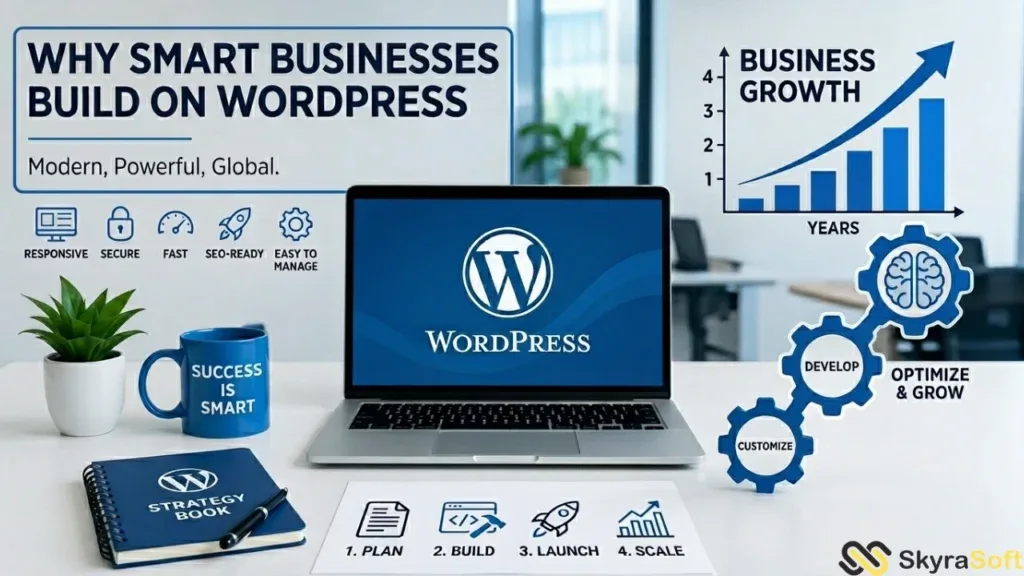
From Simple Blogs to Powerful Business Platforms
The journey of WordPress from blogging tool to business powerhouse reflects broader shifts in how companies approach their online presence. In the early 2000s, a website was largely static—a digital brochure that provided basic information about a company’s location, services, and contact details. Blogs were separate entities, often hosted on subdomains or entirely different platforms. WordPress changed this by making content creation accessible to non-technical users, but its ambitions have grown far beyond that initial use case.
Today, businesses are building complete digital ecosystems on WordPress. Consider the modern corporate website: it needs to serve as a marketing hub, a customer support portal, a lead generation engine, and often an e-commerce store. WordPress handles all of these functions seamlessly. A manufacturing company might use WordPress to showcase products, publish technical documentation, manage a dealer locator, and run a customer forum—all within a single installation. A university might use it to manage course catalogs, faculty directories, event calendars, and alumni portals. A media company might run a subscription-based news site with paywalls, member-only content, and personalized recommendations.
The e-commerce capabilities alone have transformed WordPress from a publishing tool into a transaction engine. WooCommerce, the most popular e-commerce plugin for WordPress, powers nearly 30% of all online stores—more than any other platform including Shopify. These aren’t just small shops selling handmade crafts. Major brands use WordPress to process millions in annual revenue, manage complex inventory systems, and integrate with shipping carriers, payment gateways, and accounting software.
What makes this possible is the platform’s architectural flexibility. WordPress uses a modular system where functionality can be added or removed as needed without rebuilding the entire site. A startup might begin with a simple five-page website, add a blog six months later, launch an online store after a year, and eventually build a membership portal with recurring subscriptions. Each step builds on what came before, preserving SEO value and user data while expanding capabilities. This is the opposite of proprietary platforms that force businesses into rigid templates or expensive migrations when needs change.
Unmatched Flexibility and Customization
The most common frustration business owners express about website builders is hitting a wall. You choose a template, customize it within the platform’s limited options, and eventually discover that what you really want—a specific layout, a unique feature, a particular integration—simply isn’t possible. WordPress was built to eliminate these walls entirely.
At its core, WordPress operates on a philosophy of complete control. Every element of a WordPress site can be modified: the HTML structure, the CSS styling, the JavaScript behavior, the database queries, the server responses. This level of access is unheard of in proprietary platforms, where users are confined to what the vendor decides to offer. For businesses with specific needs—whether a unique checkout flow, a custom reporting dashboard, or integration with legacy systems—this control isn’t a luxury. It’s a necessity.
The theme and plugin ecosystem amplifies this flexibility. With thousands of free and premium themes available, businesses can find a design that matches their brand aesthetic without starting from scratch. But the real power comes from customization. A theme is not a cage; it’s a starting point. Developers can modify any theme’s code, or build entirely custom themes from the ground up, ensuring that the final design is uniquely yours. The same applies to functionality. Need a booking system for appointment-based services? There are dozens of plugins to choose from, ranging from simple calendar tools to enterprise-grade scheduling systems with automated reminders, payment processing, and staff management. Want to add advanced SEO tools, multi-step forms, membership restrictions, or learning management capabilities? Plugins exist for all of these and hundreds more.
For businesses with truly unique requirements, WordPress accommodates custom development without forcing compromises. A developer can build a custom plugin that does exactly what your business needs, nothing more and nothing less. This custom code integrates seamlessly with the core WordPress system, preserving compatibility with themes, other plugins, and future updates. The result is a website that feels like it was built specifically for your business—because it was. In a digital landscape where generic template sites blur together, this distinctiveness creates competitive advantage.
Cost-Effective Yet Powerful
Budget constraints are a reality for most businesses, especially in the critical early stages of growth. Every dollar spent on technology is a dollar not spent on product development, marketing, or talent acquisition. WordPress acknowledges this reality by making its core platform completely free—not as a limited “freemium” version, but as the full, unrestricted system used by enterprises and individuals alike.
The cost advantages of WordPress extend far beyond the zero-price tag for the software itself. Development costs are significantly lower than custom-built alternatives because WordPress provides a foundation that already solves common problems. User authentication, content management, database abstraction, template handling, and URL routing are all built-in. A developer building a custom website from scratch would need to implement these features manually, adding weeks or months to the project timeline. With WordPress, they can focus on what makes your business unique rather than reinventing fundamental web functionality.
Maintenance costs follow a similar pattern. Proprietary platforms often require expensive licensing fees that increase as your business grows. WordPress has no licensing fees, ever. Hosting costs vary based on traffic and requirements, but shared hosting plans suitable for most small businesses start at just a few dollars per month. As traffic grows, you can upgrade to managed WordPress hosting, virtual private servers, or cloud infrastructure—scaling costs proportionally to your needs rather than paying premium prices for capacity you don’t use.
The global WordPress community provides another form of cost savings: free support. When you encounter a problem or want to learn a new capability, thousands of tutorials, forum discussions, and documentation pages are available at no cost. This reduces reliance on expensive technical consultants for routine issues. For businesses that prefer professional support, a thriving ecosystem of agencies and freelancers offers competitive rates, with the market competition keeping prices reasonable. Compare this to proprietary platforms where support is controlled by a single vendor, often at premium rates, and the economic advantage of WordPress becomes clear.
SEO-Friendly for Better Visibility
A beautiful website that nobody visits is a digital ghost town. Search engine optimization is the difference between being found by potential customers and being invisible to them. WordPress was designed from the ground up with SEO best practices in mind, giving businesses a significant advantage in organic search rankings.
The technical foundation of WordPress aligns perfectly with what search engines want. The platform generates clean, semantic HTML that search crawlers can parse efficiently. URLs are customizable and human-readable, incorporating keywords naturally. The codebase is regularly updated to support emerging web standards, including schema markup, mobile-first indexing, and Core Web Vitals. Page speed, a critical ranking factor, can be optimized through caching, image compression, and content delivery networks—all of which integrate seamlessly with WordPress.
But the real SEO power of WordPress comes from its ecosystem of optimization tools. Plugins like Yoast SEO and Rank Math transform complex SEO concepts into actionable guidance. These tools analyze your content in real-time, suggesting improvements for keyword usage, readability, meta descriptions, internal linking, and technical elements like alt text and title tags. For business owners who aren’t SEO specialists, this guidance is invaluable. It democratizes access to optimization techniques that were once the domain of expensive consultants.
Content creation—the engine of modern SEO—is where WordPress truly excels. The platform’s editing interface makes it easy to publish blog posts, landing pages, product descriptions, case studies, and other content types that attract organic traffic. Each piece of content can be optimized for specific keywords, structured with headings and subheadings, enriched with images and videos, and interlinked with related content. Over time, this content accumulates, creating a growing asset that generates traffic without ongoing advertising spend. A blog post published today might continue attracting visitors for years, with each new post adding to the cumulative authority of your domain.
Scalability, Security, and Long-Term Growth
The final objection that business owners raise about WordPress is often rooted in outdated information: “Isn’t WordPress just for small sites?” The answer is a definitive no. WordPress powers some of the largest, highest-traffic websites in the world, including TechCrunch, The New York Times, Sony Music, and the White House. These organizations chose WordPress not despite its scalability but because of it.
Scalability in WordPress comes down to architecture and hosting. The software itself is lightweight and efficient, but its real power emerges when paired with appropriate infrastructure. A WordPress site on shared hosting might handle a few thousand daily visitors. The same WordPress site on a properly configured cloud server can handle millions. The difference is in caching layers, database optimization, content delivery networks, and load balancing—all of which work with WordPress out of the box. As your traffic grows, you upgrade your hosting, not your platform.
Security concerns about WordPress are similarly misunderstood. The core WordPress software is maintained by a global team of security experts who regularly audit code, patch vulnerabilities, and release updates. Most security breaches on WordPress sites result not from core vulnerabilities but from outdated plugins, weak passwords, or poor hosting environments—problems that affect any platform. With proper maintenance—regular updates, strong authentication, reliable hosting, and security monitoring—WordPress sites can be extremely secure.
Perhaps most importantly, WordPress gives businesses ownership. Unlike closed platforms where your content, data, and design are locked into a vendor’s ecosystem, WordPress sites are fully portable. You control the code, the database, the files, and the hosting. If you’re unhappy with your current developer or hosting provider, you can move everything to a new provider without rebuilding from scratch. This independence ensures long-term sustainability and protects your digital assets from platform-level changes, pricing increases, or vendor shutdowns.