
The State of Enterprise Systems in 2025
In 2025, over one-third (34.7%) of enterprises used ERP software, while 28.4% used CRM systems. Among large enterprises, adoption jumps to 78.7% for ERP and 66.0% for CRM. The message is clear: successful businesses run on integrated systems. But adoption alone is not enough. The real value comes from integration.
When your ERP and CRM systems talk to each other, sales teams see real-time inventory, finance teams access customer payment history, and leadership gains complete visibility into performance metrics that actually drive profit. Without integration, these systems operate in silos, creating duplicate data, conflicting information, and manual workarounds that waste time and introduce errors.
A professionally implemented ERP and CRM solution eliminates data silos, automates workflows, and turns fragmented information into actionable intelligence. For small enterprises, adoption rates are lower – 29.2% for ERP and 23.3% for CRM – representing a significant competitive opportunity for early adopters. While larger competitors already benefit from integration, smaller businesses that implement integrated systems early can leapfrog less agile competitors.
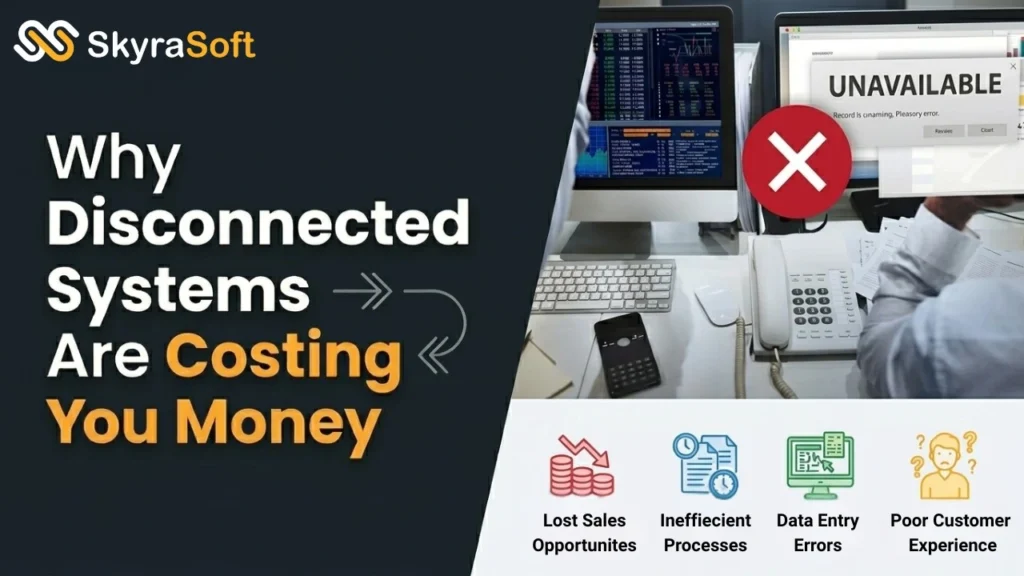
The cost of disconnected systems is not hypothetical. It shows up as duplicate data entry, missed sales opportunities because inventory information was unavailable, payment delays because billing and fulfillment systems don’t communicate, and reporting that requires hours of manual spreadsheet manipulation. Each of these costs is measurable, and together they often exceed the cost of integration.
The Real Costs of Data Silos
Data silos occur when information is trapped in one system and inaccessible to others. A CRM knows about customer interactions but not order history. An ERP knows about inventory but not sales pipeline. A marketing automation platform knows about email engagement but not purchase behavior. Each system contains valuable data, but the value is unrealized because the data cannot be combined.
The operational cost of data silos is measured in employee hours. Every time someone manually copies data from one system to another, the business pays for that time. Every time a typo is introduced during manual transfer, the business pays to find and fix the error. Every time a decision is delayed because someone is waiting for data from another department, the business pays in lost opportunity.
The strategic cost is larger. Without integrated data, leadership cannot answer fundamental questions: Which marketing channels produce the highest lifetime value customers? Which products are most frequently purchased together? Which customers are at risk of churning? These questions require combining data from CRM, ERP, marketing, and support systems. Without integration, the answers are guesses.
Compliance costs also increase with data silos. When customer data exists in multiple systems with different update schedules and different retention policies, maintaining compliance with privacy regulations becomes nearly impossible. Data deletion requests require searching every silo. Breach notifications require determining what data was where. Integration creates a single source of truth that simplifies compliance dramatically.
How Integration Drives Revenue
The cost side of disconnected systems is obvious. The revenue side of integration is equally compelling but less frequently discussed. Integrated systems directly increase revenue through better selling, better service, and better retention.
Sales teams with integrated CRM and ERP have real-time inventory visibility. They can promise delivery dates confidently, avoid overselling out-of-stock items, and identify opportunities to upsell complementary products that are in stock. A salesperson who can say “Yes, we have that in stock and it will ship today” converts more deals than one who says “Let me check with the warehouse and get back to you.”
Customer service teams with integrated systems resolve issues faster. When a customer calls about an order, the service agent sees the order status, payment history, shipping tracking, and return eligibility – all in one view. Fast resolution increases customer satisfaction, and satisfied customers buy more and stay longer.
Marketing teams with integrated systems personalize effectively. They know which products customers have purchased, which they have viewed, and which they have abandoned in cart. They can send relevant recommendations, timely reminders, and offers that match actual interests. Personalized marketing consistently outperforms generic marketing by factors of 2-5x.
Retention improves when systems are integrated. Identifying at-risk customers requires combining usage data, support ticket history, payment patterns, and engagement metrics. Integrated systems surface these insights automatically, enabling proactive retention campaigns. Increasing retention by just 5% can increase profits by 25-95% – a revenue impact that dwarfs most marketing initiatives.
The Integration Technology Landscape
Integration is no longer the expensive, custom-coded challenge it was a decade ago. Modern integration platforms have democratized connectivity, making integration accessible to businesses of all sizes.
Integration Platform as a Service (iPaaS) solutions like Workato, Tray.io, and Celigo provide visual interfaces for connecting systems. Users define triggers and actions without writing code. These platforms include pre-built connectors for hundreds of common business applications, from Salesforce and HubSpot to NetSuite and SAP. For standard integrations, implementation takes days rather than months.
API-first architecture has transformed how systems expose data. Modern ERP and CRM systems are built with comprehensive REST APIs that allow secure, real-time data access. Custom integrations can be built quickly using these APIs, and they are far more reliable than older approaches like file transfers or database links.
Event-driven integration represents the cutting edge. Instead of batch processes that run nightly, event-driven systems react immediately. When a customer places an order, events fire automatically: inventory is reserved, payment is processed, shipping is notified, and the CRM is updated – all within seconds. Real-time integration eliminates the delays and data staleness that plague batch-oriented approaches.
For businesses not ready to invest in iPaaS, low-code automation tools like Zapier and Make provide entry-level integration. These tools connect hundreds of applications through simple “if this then that” logic. While less powerful than enterprise iPaaS solutions, they solve many common integration needs at a fraction of the cost.
Building an Integration-First Mindset
Technology alone does not create integration value. Organizations must adopt an integration-first mindset, where every new system purchase includes integration requirements, every process review considers data flow across systems, and every team understands how their work depends on integrated data.
Procurement policies should require integration capabilities. When evaluating any new software – CRM, ERP, marketing automation, customer support, analytics – ask: Does this system have a documented API? Can it send and receive data in real time? Does it support webhooks or event streaming? Vendors without robust integration capabilities should be disqualified, regardless of feature appeal.
Governance structures must assign ownership of integration. Without clear accountability, integrations drift out of date, break without notice, and accumulate technical debt. An integration owner – whether a role or a team – monitors integration health, manages changes, and ensures that integration keeps pace with business evolution.
The integration imperative is not a technical detail. It is a business strategy. Organizations that connect their systems gain visibility, efficiency, and agility that disconnected competitors cannot match. In a business environment where speed and data drive success, integration is not optional. It is the foundation of competitive advantage.