The Video Production Gap
Here is the challenge: 37% of marketers say they lack the ideas, time, and tools to produce effective video content. Another 31% struggle to adapt content for different platforms, and 29% find editing too specialized and time-consuming. The gap between knowing video is important and being able to produce effective video is wide – and costly.
Raw footage does not convert. Unedited video – long pauses, awkward cuts, poor audio, inconsistent pacing – drives viewers away rather than drawing them in. Professional video editing bridges the gap between having footage and having a marketing asset that drives revenue.
This is where professional video editing becomes a strategic advantage. Professional editors understand that a 60-second video for Instagram Reels requires different pacing, different music, and different storytelling than a 10-minute YouTube explainer or a 15-second TikTok ad. They know how to structure narrative, optimize audio, color grade for consistency, and add motion graphics that clarify rather than distract.
The businesses winning the attention economy are not those with the most expensive cameras. They are those with the best storytelling. Professional video editing is not about making videos look pretty. It is about making them effective. This article explains how professional editing transforms raw footage into revenue.
The Editor’s Toolkit – Beyond Cutting and Trimming
Professional video editing encompasses far more than cutting unwanted footage. The editor’s toolkit includes capabilities that transform mediocre source material into compelling content.
Pacing and rhythm determine whether viewers stay engaged. Professional editors vary shot length, cut on action, and use music tempo to create energy or calm as the story requires. A video with consistent shot length feels monotonous. A video with varied pacing tells a story through rhythm alone.
Audio editing is often the difference between amateur and professional video. Background noise removal, level normalization, compression, and equalization make dialogue clear and consistent. Music selection and placement set emotional tone. Sound effects add texture and emphasis. Viewers may not notice good audio, but they always notice bad audio.
Color grading creates visual consistency across shots filmed at different times or in different conditions. It also establishes mood – warm tones feel friendly and inviting; cool tones feel professional and trustworthy. Consistent color grading signals professionalism even when viewers cannot articulate why.
Motion graphics and text overlays add clarity and emphasis. Lower thirds identify speakers. Animated text highlights key points. Icons and diagrams illustrate concepts. Professional editors create graphics that enhance understanding without overwhelming the content.
Transitions and effects, when used judiciously, smooth the viewing experience. Cuts are invisible; wipes, dissolves, and other transitions draw attention. Professional editors know when to use each and, more importantly, when to use none.
Narrative Structure – The Hidden Engine of Video Performance
The most technically perfect video will fail without strong narrative structure. Professional editors understand story structure and apply it to marketing video, regardless of length.
The hook comes first – often the first three seconds. In these seconds, viewers decide whether to continue watching. Professional editors ensure that every video begins with a reason to stay: a surprising fact, an intriguing question, a relatable problem, or a compelling visual. Hooks that fail lose viewers before the message begins.
The problem or context establishes why the video matters. For educational content, this is the knowledge gap. For product content, this is the customer pain point. For brand content, this is the belief or value that drives the company. Without clear context, viewers don’t know why they should care.
The solution or insight delivers the video’s core value. This is the “what you came for” – the answer, the product, the demonstration, the explanation. Professional editors ensure that this section is clear, concise, and visually supported.
The proof or evidence builds credibility. Testimonials, demonstrations, data visualizations, case studies – these elements convince viewers that the solution works. Professional editors integrate proof seamlessly rather than tacking it on.
The call to action tells viewers what to do next. Visit a website. Subscribe. Buy. Share. Download. Professional editors place the CTA at the natural conclusion of the narrative, when viewers are most receptive.
This narrative structure works for videos of any length. A 15-second TikTok has hook, context, solution, CTA compressed into seconds. A 60-minute webinar has the same structure expanded. Professional editors apply narrative thinking to every cut.
Platform Adaptation – One Source, Many Outputs
Professional video editing creates multiple outputs from single source footage, each optimized for a different platform. This multiplies the value of every production dollar.
The workflow begins with capturing high-quality source footage – often more than needed. Professional editors then create a master edit: the complete, polished video intended for the primary platform (often YouTube or website).
From the master edit, the editor creates platform-specific derivatives. For Instagram Reels and TikTok, this means reformatting to vertical aspect ratio, tightening pacing, adding text overlays (since sound is often off), and shortening to platform-appropriate length. For LinkedIn, this might mean a square aspect ratio, professional titles, and a focus on educational value. For ads, this means multiple cuts of different lengths (6, 15, 30 seconds) with front-loaded hooks.
Thumbnails and social cuts are additional outputs. A strong thumbnail dramatically increases click-through rates on YouTube and social platforms. Social cuts – 15-30 second highlights from longer videos – serve as teasers that drive viewers to the full content.
This multiplies the ROI of video production. One day of filming and one editing project produce assets for every channel, each optimized for its specific audience and format. Businesses that produce platform-specific video outperform those that post the same video everywhere.
Building a Video Editing Workflow That Scales
Professional video editing is not a one-time project. It is an ongoing capability that scales with your video production volume. Building a workflow that works at scale requires systems, not just talent.
The first system is asset management. Raw footage, music, graphics, project files, and outputs need organization. Consistent naming conventions, folder structures, and backup procedures prevent the chaos that slows down editing. Cloud-based tools like Frame.io enable review and approval without emailing files.
The second system is templating. Recurring video types – customer testimonials, product explainers, social ads – benefit from templates. Templates define length, structure, graphics, and music, allowing faster editing while maintaining quality. Templates also ensure brand consistency across videos from different editors.
The third system is review and approval. Clear roles, deadlines, and feedback processes prevent endless revision cycles. Tools that support timestamped comments, version comparison, and approval workflows reduce friction between editors and stakeholders.
The fourth system is performance measurement. Tracking which videos perform best, at what length, with what structure, on what platforms provides the data for continuous improvement. Editors who see performance data make better creative decisions.
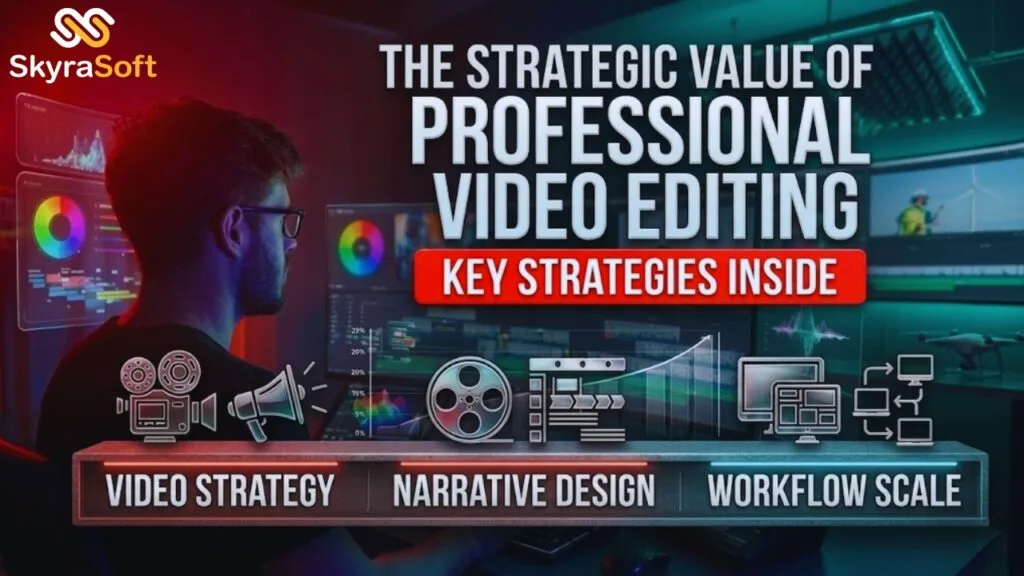
The strategic value of professional video editing is not in any single edit. It is in the capability to consistently transform raw footage into content that engages audiences and drives revenue. Businesses that build this capability capture the attention economy’s most valuable currency. Those that don’t watch their competitors do so instead.